How to Prepare Lender-Ready Financial Records Before You Apply

The best time to organize a financing file is before the business urgently needs cash. A rushed application often exposes unfinished bank reconciliations, outdated financial statements, undocumented owner transactions, or a loan request that has not been tied to a clear repayment plan.
Credit conditions were relatively stable in the Federal Reserve's July 2026 bank survey. That does not mean every qualified applicant will receive the full amount requested. Current records and a specific use of funds help a lender understand the request. They also help you decide whether the proposed debt fits the business.
Key Takeaways
Stable credit conditions do not guarantee approval or the full amount requested.'
Define the amount, use of funds, timing, and expected repayment source before collecting documents.
Reconcile the accounts and make sure the financial statements, bank records, debt schedule, and forecast tell the same story.
Test repayment under expected, lower-revenue, and higher-cost scenarios, and prepare a plan for partial approval.
Quick Links
Stable credit standards do not mean automatic approval
The Federal Reserve's July 2026 Senior Loan Officer Opinion Survey found that banks generally left commercial and industrial lending standards basically unchanged for firms of all sizes. A moderate net share reported narrower loan-rate spreads for small firms, and demand from small firms was basically unchanged.
The survey included 56 domestic banks and 18 U.S. branches and agencies of foreign banks. Within this survey, a small firm is one with annual sales below $50 million. The results describe lender conditions; they do not predict the outcome of a specific application.
Borrower outcomes provide a second piece of context. In the Federal Reserve's 2026 Report on Employer Firms, 60% of respondents applied for financing during the prior 12 months. Among applicants, 42% received the full amount sought, 36% received some or most, and 22% received none.
The report is based on a nationwide convenience sample of 6,525 employer firms with 1 to 499 employees. It is useful for direction, but it is not a random-sample estimate for every U.S. small business.
Define the request before collecting documents
Start with four details: the amount, the use of funds, the timing, and the expected source of repayment. Avoid a broad description such as “working capital” when the request can be stated more precisely.
For example, a business may need to fund a 60-day gap between payroll and client collections, purchase equipment that expands capacity, open a second location, or refinance debt with an approaching maturity. Each purpose calls for different supporting detail.
The Federal Reserve survey found that 56% of applicants sought financing to meet operating expenses, while 46% sought funds for expansion or a new opportunity. Financing for operating expenses deserves careful review. A short collection delay is different from a recurring monthly deficit. A cash flow forecast can show which condition exists and whether debt would resolve it.
The SBA Lender Match guidance also advises borrowers to know how much funding they need, how the funds will be used, and how the business will repay the financing. Those answers should be consistent with the reports in the application file.
Core Financial Package

Year-to-date profit-and-loss statement | Include a comparison with the same period from the prior year when possible. Explain material changes in revenue, payroll, rent, insurance, and other operating expenses. |
Current balance sheet | Review cash, receivables, payables, loans, credit cards, owner equity, and unusual balances. Old clearing-account amounts or negative asset balances should be resolved before submission. |
Cash flow statement or forecast | Show how cash is generated, when major payments occur, and how the proposed loan payment fits. |
Accounts receivable and payable aging reports | If applicable, these reports help explain expected collections and near-term obligations. |
Debt schedule | List each lender, original balance, current balance, interest rate, monthly payment, maturity date, collateral, and guarantor. |
Business bank statements | Provide the requested period and make sure the activity agrees with the bookkeeping records. |
Use-of-funds schedule | Break the request into equipment, payroll, inventory, tenant improvements, refinancing, professional fees, or other specific uses. |
Financial projections | State the assumptions behind revenue, expenses, timing, and repayment. Separate contracted activity from hoped-for growth. |
Supporting explanations | Prepare short notes for one-time expenses, unusual deposits, ownership changes, large receivables, or recent performance shifts. |
Support4B's overview of financial statements for small businesses explains how the profit-and-loss statement and balance sheet work together. A lender will often compare the reports instead of reading each one in isolation.
Reconcile the records before submission
Bank and credit-card reconciliations connect the accounting records to the financial institution's activity. Unreconciled transactions can distort cash, expenses, debt, or owner distributions. They can also create avoidable questions during underwriting.
Complete the reconciliation for every account through the most recent closed month. Then review outstanding checks, deposits in transit, duplicate entries, transfers between accounts, and transactions without supporting detail. The Support4B bank reconciliation guide explains the role this process plays in a reliable monthly close.
If an adjustment is needed, document the reason. A clean explanation is more useful than forcing an entry to make a balance appear correct.
Test repayment under more than one scenario
A projection should show how the business expects to make the payment. It should also show what happens if collections arrive later, revenue grows more slowly, or a major expense increases.
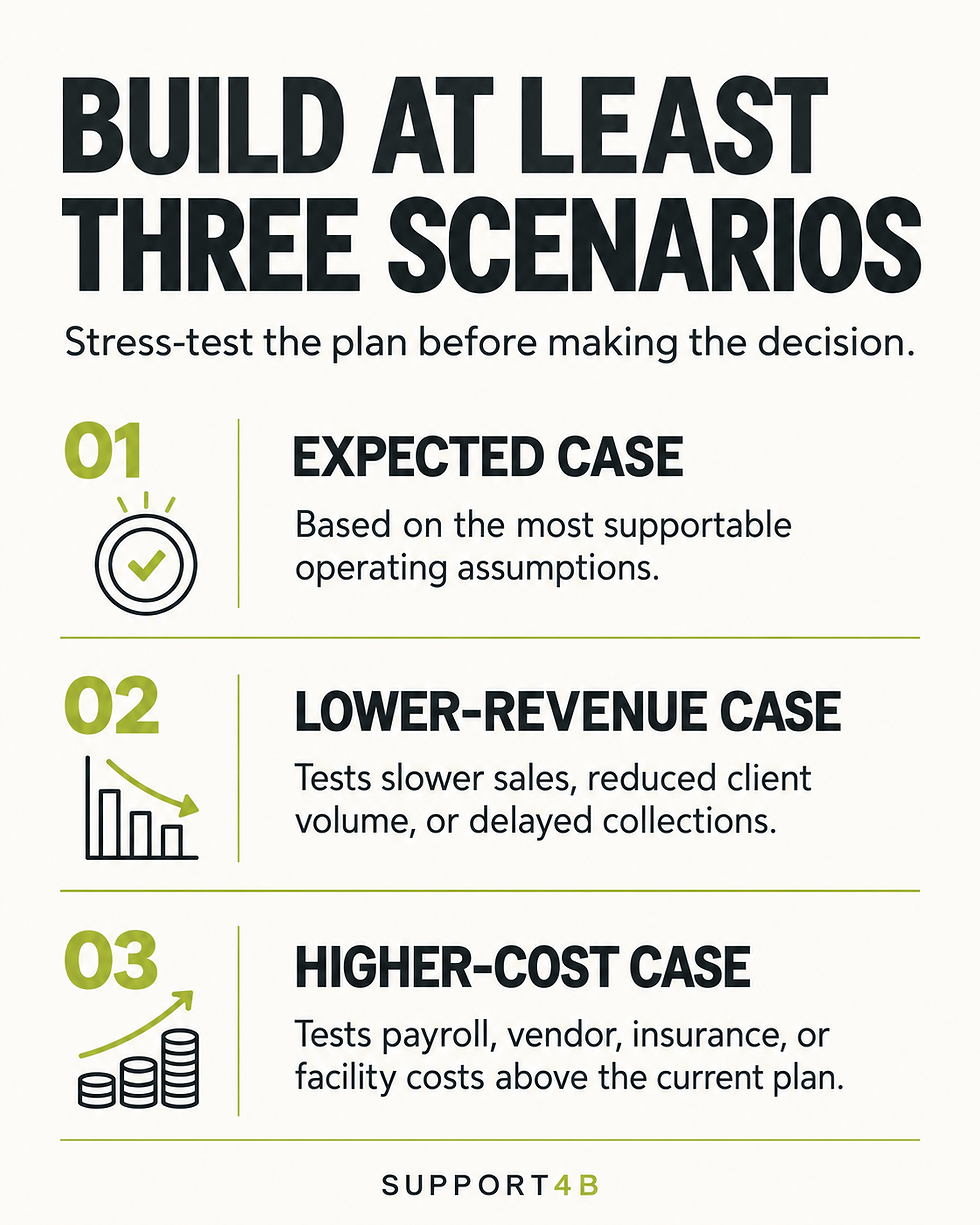
Review the monthly ending cash balance and the point at which the loan payment begins. If repayment depends on immediate growth with no allowance for delay, the requested amount, timing, or project scope may need revision.
Prepare for a partial approval
The Federal Reserve applicant data show that receiving less than the full amount is common. Decide in advance what the business would do with 75%, 50%, or none of the requested financing.
Identify which project costs are essential, which can be delayed, and which require the full amount to be viable. Do not begin an indivisible project with partial funding unless the remaining source is confirmed. This planning also helps you respond clearly if a lender proposes a smaller amount, different term, or additional collateral requirement.

A lender-readiness review to complete now
Use this checklist 60 to 90 days before you expect to apply:
✅ | Close and reconcile all bank and credit-card accounts through the latest month. |
✅ | Review the balance sheet for old, negative, or unexplained balances. |
✅ | Prepare current and comparative profit-and-loss statements. |
✅ | Update accounts receivable and payable aging reports. |
✅ | Build a complete debt schedule. |
✅ | Document the requested amount and each planned use. |
✅ | Prepare a cash flow forecast that includes the proposed payment. |
✅ | Write brief explanations for material changes or one-time events. |
✅ | Confirm that the application, bank statements, and accounting reports tell the same story. |
Timely monthly bookkeeping reduces the amount of cleanup required when an opportunity appears. It also gives you a current view of whether financing supports a temporary need, an expansion plan, or a deeper operating issue.
Make the application easier to evaluate
Lender-ready records cannot guarantee approval. They can reduce ambiguity, support the requested use of funds, and show how repayment was evaluated. The same preparation also gives you a better basis for deciding how much to borrow and when to proceed.
If you are considering financing, Support4B can help organize the financial statements, reconciliations, debt details, and cash flow reports needed for a more complete application file.

